The lady who Lives in the Windmill
On the anniversary of my first sons death, I used to do something away from the ordinary day-to-day, and travel to new experiences, to have a story to share upon my return.
In the winter of 1986 I went to Madeira. I got a return only flight for New Year's Day for £50
Just like all the business trips I had made, this one started off as smooth as silk, but when I reached Madeira airport, I would soon realise the folly of expecting to find a hotel bed on January 1st.
I had my backpack, and thought it would be fun to walk from the airport to the capital Funchal. After a while I came to my senses, and went back to the airport and just managed to hail the last taxi.
Of course, the driver wanted to get home to his family, after all, it was almost midnight. We stopped at several hotels, where he got out and made enquiries, always without any luck, until eventually he told me he was going home, took the fare and left me standing alone on the pavement.
Not having the foresight to get a map, I wondered about until I came across a rather nice park overlooking the harbour. I found a fairly secluded park bench, got out my sleeping bag and dozed fitfully and uncomfortably for minutes at a time.
As soon as the street lights had gone out, and the dawn was breaking, I set off in search of some breakfast. By mid morning, I felt fortified and went to look for the tourist information shop. I soon found out from the very polite staff, that there were no beds to be had in Funchal for at least a week.
I was also informed that if the police found me sleeping rough, I would be arrested. (I didn't think this one through - as I could at least have had a comfortable bed for the night, albeit in a cell)
One ray of hope was the ferry to Porto Santo. I was unaware that the place existed, and jolly soon went down to the quay to book a ticket. my luck was in, I bought ticket sitting in the comfortable aluminium catamaran whose cabin was the size of a jumbo jet.
As soon as we left the harbour we encountered a wonderful Atlantic swell which rushed us down into each trough and rose up like some magical fairground ride.
Unfortunately, some of the passengers did not enjoy the ride as much as I did, and immediately started being sick. After 10 minutes, the captain announced that the sea was too rough and we would be turning back to the harbour and everyone would be offered a trip the following day.
This scuppered my sleeping arrangements, so I had to think on my feet.
looking at the coastline, I guessed that within a few miles of walking along the coast road I would be able to find somewhere out of the way to spend the night.
I decided to walk along the coastal road until I could find somewhere suitable to pitch up for the night. The Sun was setting as I made my way around the first headland, from which I could see a bay with lights and houses.
I walked purposefully through the village towards the next headland. As I rounded it, a similar scene presented itself.
And so it went on, each headland gave way to a bay strewn with houses.
I realised that every piece of land that was not precipitous, was either farmed or built on. It was then that I noticed a lane branching off the coastal road, leading up into the mountains.
After a short while, I found a track leading off the lane onto a grassy knoll.
It was secluded and dark. I took off my backpack, climbed into my sleeping bag, eight and orange, and a small tub of yoghurt and fell asleep.
As the dawn broke, I turned over and realised that I had been sleeping next to a precipice, and the sound that I thought was the distant sea was in fact a stream running over large boulders.
Soon I was walking back along the road towards Funchal, and when a bus approached me from behind, I signalled it to stop and had a ride into town, which was fortunate, because had I walked, I would have missed the ferry.
This time, the sea was kinder, and the ferry took us the 43 km to the island of Porto Santo.
Of course, all this was before the building of the airport and subsequent development. A taxi took me to a hotel next to the beach which I was pleased to find had rooms to spare.
Taking a walk along the beach, I came across a little shack where a man sold drinks and snacks. Lying on the sand a short way away was a dog. He did not look well cared for.
On the way back to the hotel, I saw something Move, and discovered a cat, which was obviously pregnant. I squatted down and waited for it to come and see me. She was not very old and had a pretty face. I gave her a stroke, she purred, and I wondered where she lived.
That evening in the hotel restaurant I had steak and chips with a glass of red wine, followed by a chocolate pudding. I was sitting by the window overlooking the swimming pool, and there was the cat walking purposely towards me. I cut up some of my steak into small cubes, wrapped it in the napkin and stuffed it into my pocket.
When the meal was over, I went outside and sat on the steps of the pool. It was dark, and there was nobody around, except for the cat. I retrieved the pieces of steak, and then saw my dog from the beach, walking silently up to sit at my feet beside the cat.
"Ladies first" I said, holding out a morsel of steak for the cat.
She took it delicately. I turned to the dog and said "now it's your turn, you've been very patient" I held out the next morsel of steak and, like the cat, he took it gently from my fingers.
One by one in turns I gave them the scraps until they were all gone, then I held my hands out and said "no more until tomorrow". And so for the next few days, there was something almost spiritual about the cat and the dog silently coming out of the shadows into the moonlight to share my meal each evening.
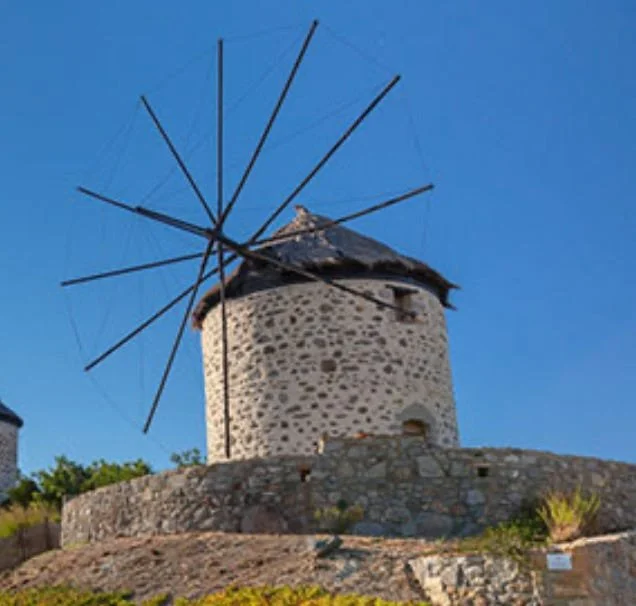
In the hotel foyer, amongst the notices on the bulletin board, was a card advertising ColorTherapy. Intrigued, I rang the number and a woman answered. Her name was Mrs Woods, and she told me that she lived in a windmill, and that if I hired a taxi he would know where to take me, so I made an appointment for the next afternoon.
A dirt road lead lazily up a bare hill outside the town to a group of windmills. He pulled up outside the one Nearest the top of the hill. I paid him, and, as I approached, a bare wooden door opened and a smiling elderly lady greeted me.
I was ushered into the small circular room and she offered to make me a cup of tea. As she was doing this, I looked around, wondering if this was her main residence. (It was an idyllic holiday home whilst married, she was later to tell me).
My eye was taken by a large oil painting depicting a girl in a garden carrying a basket of fruit on her head. The colours were vibrant and it reminded me of Paul Gauguin.
Mrs Woods told me a great deal about herself, and when I asked her about colour therapy, she looked at my purple sweater and bottle green jeans and said "you don't need any ColorTherapy" and, like a child being late into an unknown adventure, I didn't question her and listened to the rest of her story.
Over several cups of coffee, she told me her life story, from her happy childhood in England, her travelling to the Bahamas, where she became the first female news reader on the radio. How she met the heir to a Madeira wine fortune, and how when he died, it transpired that their wonderful lifestyle had been bought at the cost of the family business. When the debts had been paid, she was left with nothing but the Windmill.
Before I left, she offered to show me round the island on the next day, and added that she had gone back to England to visit a friend, and had been on a course to become a colour therapist. Her friend told her that when she went back to Madeira, an Englishman would come and help her. Oh dear, I thought. Sounds like I've got a job.
She did show me around the island, we had a nice meal and I had my first taste of custard apple. I learnt that she was a correspondent for a Portuguese national newspaper, but they printed few of her articles about Madeira, so consequently, her income was small.
The next day she invited me to lunch, and afterwards brought out a large tin containing her important documents. She wanted me to look through them, because she was unsure of some of the legal meanings (so she said).
It transpired that the windmill did not belong to her. Before he died, her husband had sold it to a doctor, who had the use of the upper floors, and the ground floor remained for the use of his widow during her lifetime. Mrs Woods was not, pleased to discover this.
When I told her that I needed to go back to Madeira for a few days before my flight to England, she offered to come with me, as there was another document, which was the title deeds to a plot of land in Madeira.
She had never visited the site, and this was the reason for her wanting to travel with me. She was sure that I would be able to find the land for her, and she would be able to sell it. It seemed like an interesting thing to do.
In the meantime, I had left the hotel and rented a small apartment by the sea. It was nice to be on my own, to think and write, and explore the old town which contained the Church where Christopher Columbus had been married.
I climbed the wooded hill that had been planted a century before by an Englishman, so that it would trap the moisture in a perpetual mist and supply Town's water through leats that spiralled down the hill into a reservoir. A very clever idea I thought.
I had with me the painting that had so captivated me in the Windmill. Mrs Woods had noticed me looking at it, and offered to sell it to me for half the price her husband had paid for it in the Bahamas before they were married.
I was reluctant to take it, as it obviously had great sentimental value to her. But she insisted, telling me that she needed the money more than the painting. I gave her £100 and she gave me a receipt for £50 saying that I may have to pay import tax on it when I got back to England.
Each morning, when I awoke, the lady in the painting greeted me enigmatically. It was almost as if I knew her, from a dream maybe, or perhaps a past life?
When the dawn came on the day, we were to take the ferry to Madeira, I packed everything, and made my way along the harbour to the ferry. When I reached it, I realised that I had left the painting wrapped in paper, tied in string, and leaning against the outside wall of the kitchen. I ran all the way back to the apartment to retrieve it..
Mrs Woods was very friendly with the young captain of the ferry, and as soon as it was underway, she took me up to the bridge, introduced me to him, and we stood on the bridge all the way back to Madeira, watching the waves and chatting to the captain.
One of the things I asked him was, what would happen if there were a fault in the circuitry between the little joystick on the arm of his chair and the hydraulic rams operating the rudders.
He explained that, indeed, this had happened some weeks previous, and that they had had to circle until the engineer had rectified the fault. I looked at the engineer who was writing something on a sheet paper.
In front of him red lights winked on a console. One of them was something to do with gearbox oil temperature. I asked the engineer what he was doing, and he replied, “filling in my football pools”.
The next day I had breakfast with Mrs Woods in the hotel, and then we went to hire a car. I had a map of Madeira and somehow, on the far side of the island we managed to find the plot of land that she owned. the nearest we could get to it by car was about half a mile away at the end of a steep unmade track.
Parking the car, we took a footpath leading up the side of the hill and eventually found what was probably her plot.
It was wooded and precipitous. Below it, slightly less steep, was another plot on which stood, propped up on timbers, a wooden shed. It was quite dilapidated and could have been used in the past as storage for camping equipment.
Mrs Woods hid her disappointment, and told me that maybe somebody would buy the land from her for recreational use. I marvelled at how she could maintain her enthusiasm for life in the face of such loss and concealment. I think I learnt something from her.
The next day I was to leave for home. I packed everything the night before, as the flight was quite early, and booked a taxi. After breakfast, I took my backpack to the lobby and when the taxi arrived, I put it in the boot, sat in the passenger seat and then remembered - the painting was still in my room.
I asked the taxi driver to wait, ran back into the lobby, asked for the key to my room, ran up the stairs, went in, picked up the painting and ran all the way back to the taxi. The journey to the airport was short and uneventful.
The airport lounge was quite small, and as there was only one runway, it was not crowded. Eventually, the doors were opened, and we filed out to the waiting steps by the aircraft.
I remembered the painting, ran back to the airport lounge, picked up the painting, and went to join the end of the queue for the flight to Heathrow. The air hostess was very helpful and offered to put my painting at the back of the plane where it would be safe.
The takeoff was smooth, in complete contrast to the landing, which had been so turbulent, passengers were crossing themselves, prying, and when the plane had finally come to a halt, had broken out into spontaneous applause.
I never really look forward to immigration. It is something to be borne, and I find the best thing to do is to occupy myself with thoughts of the future.
The queues seemed to stretch in front of me for an hours worth, and after about 10 minutes, imagining myself passing happily through the green gate, I remembered the painting.
Quickly I retraced my steps, desperately hoping that my memory would take me back to the plane I had arrived on, as there were no signs saying "this is the way to the plane you arrived on".
As I made my way onto the plane, I was greeted by team of cleaners. "Is this what you were looking for" said one of them, smiling and holding the painting. I took it gratefully and made my way back to the end of the immigration queue.
I found my way without too much trouble to the underground station, and sat down to wait for a train to take me to charing Cross station. I did not have long to wait.
After about 30 minutes on the train, I suddenly realised that I had left the painting on the station at Heathrow. I got off at St James's Park, crossed over to the other side and took the next available train back to Heathrow.
Of course, when I reached Heathrow I looked across at the up platform and realised that my painting was not by the bench where I'd sat.
Fortunately, nearby was the restroom for the Station staff. I knocked politely on the door and a guard holding a mug of tea, opened it for me. "Has anybody handed in a painting"? I asked hopefully.
"What sort of painting"
"A large one" I indicated with my hands the size.
"Would it be an oil painting"
"yes"
"What is the painting of"
"A lady in a garden holding a bowl of fruit on her head"
He turned and walked to the back of the room and returned holding my picture.
"Would this be your picture" he said grinning like a Cheshire cat.
"Yes" I said, relieved at being reunited with her.
By the time I got to charing Cross station, it was quite late, and I had a long wait for my train back home. The ride home through Kent was uneventful.
I had made the journey hundreds of times when I was working in the West End. As you have probably guessed, when the train reached my station, I got off with my backpack, slammed the door and then remembered the painting.
The announcement came over the tannoy that all passengers for the branch line to Maidstone should change now. This just gave me time to get back on the train and pick up my painting.
Unfortunately, the connecting train to Maidstone was just leaving as I struggled through the tunnel and up the steps to the adjoining platform.
It was the last train. There were no buses, the weather was fine and I decided that I would walk the three miles home.
When I arrived, the house was empty, I left the painting in the hall and was soon asleep in my own bed. In the morning I was awakened by my daughter. She asked me if I had enjoyed my holiday, and also why I had left the painting in the hall. She didn't like it. It gave her the creeps. So, I put it in my bedroom and there it stayed until I sold the house.
I did take a photograph of it, and sent it to Sotheby's, who said that they had no record of the artist, but they would send it to their office in New York. Eventually, I got a reply saying that the New York office also had no record of the artist, which meant that I didn't have to insure the painting separately from my household goods.
Time passed quickly, as I travelled the country with my daughter, selling my children's books. Then, one day, I met a young artist who would become my second wife. How this happened, and what transpired is the subject of another story, but as soon as we had to set up home in a beautifully converted old village school in Yorkshire.
The painting was unwrapped, it elicited the same response as it had with my daughter. There was no question about it. She had to go (the painting, of course – not the wife - she left later).
That very day, I drove into Thirsk and found the charity shop Mind.
I was early, and there was just one lady unlocking the shop. I asked her if she would like a painting. I took it into the shop and she unwrapped it. In sharp contrast to my daughter and my wife, she fell in love with it.
"it's beautiful" she said, "how much do you think we should sell it for"
I told her that I had paid £100 for it, and that I was sure the charity shop should get 60 for it.
"That's fine, I'll buy it myself" she said smiling.
I drove home, happy to have known the girl in the painting, and that she had gone to an appreciative home.